
Using Motivation Strategies to Retain Great Teachers

Across our nation, the need to retain our most effective teachers has become a crucial priority for school districts. A teacher shortage is forcing school districts to fill many classrooms with new and nontraditional teachers at an alarming rate. It is essential that our most effective teachers feel valued and motivated as we ask them to shepherd this large number of less-experienced educators.
What keeps great teachers in the classroom every year with the same spark they had at the beginning of their career? Are they just wired differently, or are there other factors that feed their teaching passion? The good news for principals is highly effective teachers are human, and most humans respond to motivation. The trick is to figure out what motivates successful teachers and which specific motivators will encourage each of them. People who are motivated by their work tend to stay with that work, so let’s explore how principals can leverage opportunities for teachers to become motivated and engaged.
People can be motivated both extrinsically and intrinsically. Extrinsic motivators are imparted by others. Administrators have more direct control over these motivators and can make conscious choices about their allocations. Intrinsic motivators are the drivers that rewarded individuals perceive for themselves. Intrinsic rewards cannot be bestowed upon teachers directly, but it may be possible to arrange circumstances that enhance the possibility that teachers will perceive these intrinsic rewards more often. Knowing the motivational triggers for each of your teachers will help determine the appropriate action or situation to spur their motivation positively.
Let’s first examine the possible extrinsic motivators that principals might control.
Extrinsic Motivators for Highly Effective Teachers
Compensation
Maybe the most obvious motivator is the power the principal has over a teacher’s compensation. Principals typically decide whether a teacher is recommended for rehire. They also approve career ladder and extra-duty contracts. Principals are often allowed to promote teachers to positions within the building. Offering promotions such as department chair, instructional coach, lead teacher, or committee chair is typically seen as positive motivation when accompanied with a monetary reward.
Resources
Principals manage resources. Procuring and distributing instructional materials or providing planning time within the daily schedule are examples of resources that allow great teachers to do their jobs more successfully. This can be a strong motivator.
Challenge
Our best teachers have climbed the educational mountain. They have mastered the instructional challenge of the classroom. These teachers may need motivation from sources outside of the classroom. They may desire experiences that allow them to encounter other educational endeavors such as serving on building or district committees, providing professional development for peers, having opportunities to be involved in research, or assuming building leadership. The principal has the power to extrinsically motivate through these assignments.
Teaching Assignments
Teaching assignments impact a teacher’s life daily and therefore are a huge source of motivation that can be perceived as either positive or negative. Would your most productive teachers thrive while being assigned to their favorite content, or do they need the challenge of teaching something outside of their comfort zone? Assignments regarding grade level, student ability (honors, accelerated, tier 2 or 3), and management needs of students can be perceived as positive or negative motivators. Some great teachers want the challenge of taking on students who struggle academically or are more difficult to manage while others shine when inspiring students to exceed academic expectations.
Teaching assignments are also about the people with whom you teach. Some highly effective teachers want to teach with people who challenge them and have equal expertise in the classroom while others may be charged by teaching with a team that needs their knowledge and experience. The peers you work with can be a powerful motivator or a source of disdain.
Recognition
Receiving recognition in the form of feedback, praise, and support are strong intrinsic motivators, but we can’t ignore the fact that the principal must initiate these actions. Even the greatest teachers want to know the person in charge (the principal) and their peers recognize their accomplishments and success. Having effective feedback conversations with teachers gives principals an opening to acknowledge a job well done. Specific feedback is critical to maintaining teacher motivation. Highly effective teachers typically don’t want a lot of public praise, but the occasional name in the weekly memo or recognition at the faculty meeting is likely appreciated.
Intrinsic Motivators for Highly Effective Teachers
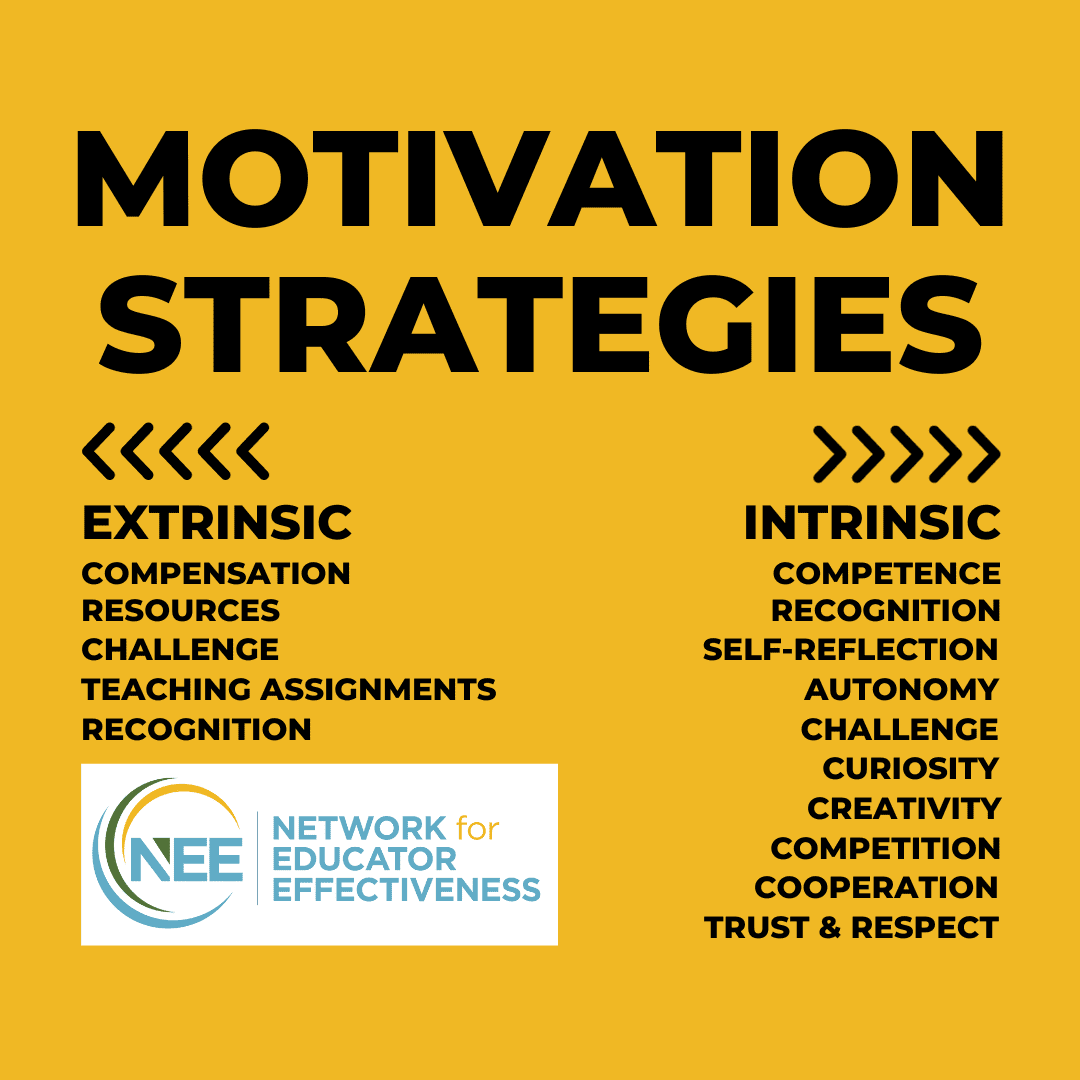
Let’s explore the impact of intrinsic motivators next. If a person is to be motivated intrinsically, it must come from a place of personal value. The impetus for the motivation is due to a person’s interest, enjoyment, or satisfaction in whatever behavior they are engaging in. They participate in the activity because it makes them feel gratified and fulfilled. They sustain the activity because it pleases them. Principals can’t make someone feel this way, but they can impact the opportunities and frequency with which teachers are exposed to these situations.
Personal achievement and self-confidence are arguably the two intrinsic motivators that have the most positive impact on highly effective teachers. Understanding these motivators and their drivers is essential if principals are going to foster intrinsic motivation.
Personal Achievement
As I have observed successful teachers over the years, most of the great ones are driven by a sense of personal achievement. The definition of personal achievement varies from teacher to teacher. Some find great satisfaction in impacting student achievement. Many teachers define true personal success as the ability to form strong relationships with students, especially those students who others have failed to reach. Teachers can find personal satisfaction in leading other teachers, and teachers may experience a sense of personal achievement by providing extraordinary classroom experiences for their students. How can principals facilitate this sense of personal achievement in highly effective teachers? Utilizing the following drivers will promote personal achievement:
Competence
Competence can be measured in the alignment of our goal with the knowledge and skills we possess. Teachers must feel capable of achieving the task at hand. Even master teachers will struggle if they are not confident in their ability. Principals should not take for granted that these teachers are always equipped with the skills and knowledge for each experience presented to them. Personal achievement relies on the teacher having the right tools for success. Assess the teacher’s level of competence before offering the challenge. Highly effective teachers will get up to snuff when given the time and resources needed to become competent.
Recognition
Principals can help teachers recognize their accomplishments. Collecting data that will expose a teacher’s achievements is the job of the principal. This data is not limited to student achievement results. The data could be student survey findings, discipline trends, student work, classroom observation notes, leadership accomplishments and plans, etc. Teachers must recognize their achievements before they can become motivators.
Self-reflection
As important as sharing data is, encouraging teachers to discuss and analyze their data and results is equally important. Using a reflective feedback or micro feedback style will allow teachers to explore their growth and achievement. This self-reflection and recognition of personal achievement can be highly motivating.
Motivation Through Self-Confidence
Self-confidence is a powerful incentive that motivates highly effective teachers. Feeling empowered through conviction and assurance inspires teachers. Principals’ actions can positively or negatively impact these feelings. Identifying these actions and understanding their consequences as they relate to teacher motivation will give principals an advantage as they support and encourage teachers’ self-confidence. Let’s examine the drivers that promote motivation through self-confidence.
Autonomy
Highly effective teachers want control over their teaching. They want to call the shots in their classroom. They want to be supported but not micromanaged. When new goals are set for the building, they want to implement them in their way. They want the freedom and respect to make decisions that impact their students. Autonomy will only be realized if teachers feel they are part of a risk-taking culture. Principals must openly communicate to deserving teachers that they are trusted.
Challenge
Highly effective teachers want to be challenged. They have conquered day-to-day teaching and need to test themselves through new confrontations and experiments in the classroom. It is the thing that breathes new life into their teaching, and they thrive on it. These challenges can be in the form of new instructional strategies, new curricula, research, new teaching assignments, and leadership positions that require them to solve building issues inside and outside the classroom. Highly effective teachers are problem solvers; help them to find their next test.
Curiosity
Our best and brightest teachers are inquisitive. They are thinkers who have interests, awareness, and concerns for all life has to offer. Encouraging them to harness this curiosity and bring it to life in the classroom will be seen as a positive motivator. Teachers can be motivated through micro-feedback conversations that allow them to explore the future focus of their teaching. Ask them what things they would be curious to try in their classroom. Give them permission to explore their wonders and bring novel ideas to our profession.
Creativity
Great teachers often show creativity when delivering instruction and providing learning activities. We come to expect it from them, but are there other ways for them to use this creativity? What if they were allowed to plan the next in-service with the charge to make it different? Is there an issue in the building that needs to be addressed? Let them take responsibility. Is it time to think outside the box about curriculum? Many highly effective teachers have the desire and credibility to lead their peers to creative solutions. It is invigorating to tackle issues from new and innovative perspectives. Using their creativity in this way will allow them to stand out, build new relationships, increase self-confidence, and exercise their creative muscles.
Competition
Sometimes competition is seen unfairly as an ugly trait, but highly effective teachers often thrive on it. It is their subtle chance to establish themselves at the top of their game. It allows them to prove to themselves and others that they are among the best. It can be quite the motivator when done with integrity. The best teachers don’t want a banner that says, “I am the best,” but they will find satisfaction in things that showcase their talents and allow others to admire their efforts. Allow these teachers to display student work, and comment in the faculty memo on something specific you saw in their classroom. Put them into positions of leadership that indicate their value to others.
Cooperation
Even the greatest of teachers is motivated by working with a team if the team is effective. Working in a collaborative situation feeds all the other motivational drivers. Teaching can be difficult and exhausting; even superstars can fall victim to its effects. The simple act of working on a team to tackle challenges is motivating. Sharing that sense of obligation makes things seem more manageable and more hopeful. We need the effects of teamwork for all teachers, but we can’t forget that our highly effective teachers carry a heavier load of expectations for themselves and the institution. Teamwork can help that load seem a little lighter. Teams need to be successful if they are going to motivate positively. Principals can help increase the effectiveness of a team by instilling collaborative processes and providing needed resources.
Trust and Respect
When teachers feel trusted and respected, the road to self-confidence is open. Nurturing a sense of trust and respect for the teacher provides the safety net they need to be bold in their teaching practice. Principals that establish a climate for risk-taking without fear of repercussion can boost a teacher’s self-confidence. Inviting teachers to share in decision-making demonstrates trust in a teacher’s ability. When highly effective teachers feel supported, they gain self-assurance and become empowered. Principals support this response by being in classrooms to acknowledge and show empathy for difficult teaching situations and accomplishments. Principals who follow through with promises and commitments show respect for the teachers they serve.
Motivation pushes us to attempt new challenges with the belief that we will succeed. Motivation must be fed and nurtured for our most highly effective teachers. It is what keeps them growing and succeeding. Without motivation and its effects, we risk losing or dimming our most valuable educational resource: the successful teacher. The role principals play in teacher motivation is vital. Principals must understand the drivers of motivation and the impact each will have on their teachers. I encourage you to take some time to examine the actions you are taking and the opportunities you might be missing to build motivation in your highly effective teachers.
Cheri Patterson is a trainer and field support representative for the Network for Educator Effectiveness. She joined NEE in 2013 after an extensive career in K-12 education as a teacher, principal, and associate superintendent.
The Network for Educator Effectiveness (NEE) is a simple yet powerful comprehensive system for educator evaluation that helps educators grow, students learn, and schools improve. Developed by preK-12 practitioners and experts at the University of Missouri, NEE brings together classroom observation, student feedback, teacher curriculum planning, and professional development as measures of effectiveness in a secure online portal designed to promote educator growth and development.