Advanced Practices for NEE: Moving Beyond Compliance Toward Continuous Improvement
For many schools, the Network for Educator Effectiveness has become a familiar and established part of the performance evaluation process. Classroom observations, feedback conferences, and evaluation cycles are already built into the rhythm of the school year.
However, after districts become comfortable with the foundational pieces of NEE, the next challenge emerges: How do schools move beyond simply completing evaluations and begin using the system as a true driver of instructional growth?
The power of NEE is not found in any single tool or task. Instead, its strength comes from how all the pieces work together to support teachers and improve instruction.
Let’s explore how districts can deepen implementation, improve the quality of feedback, strengthen calibration, and more intentionally connect observation data to professional development.
Advanced Practices for Scheduling Observations
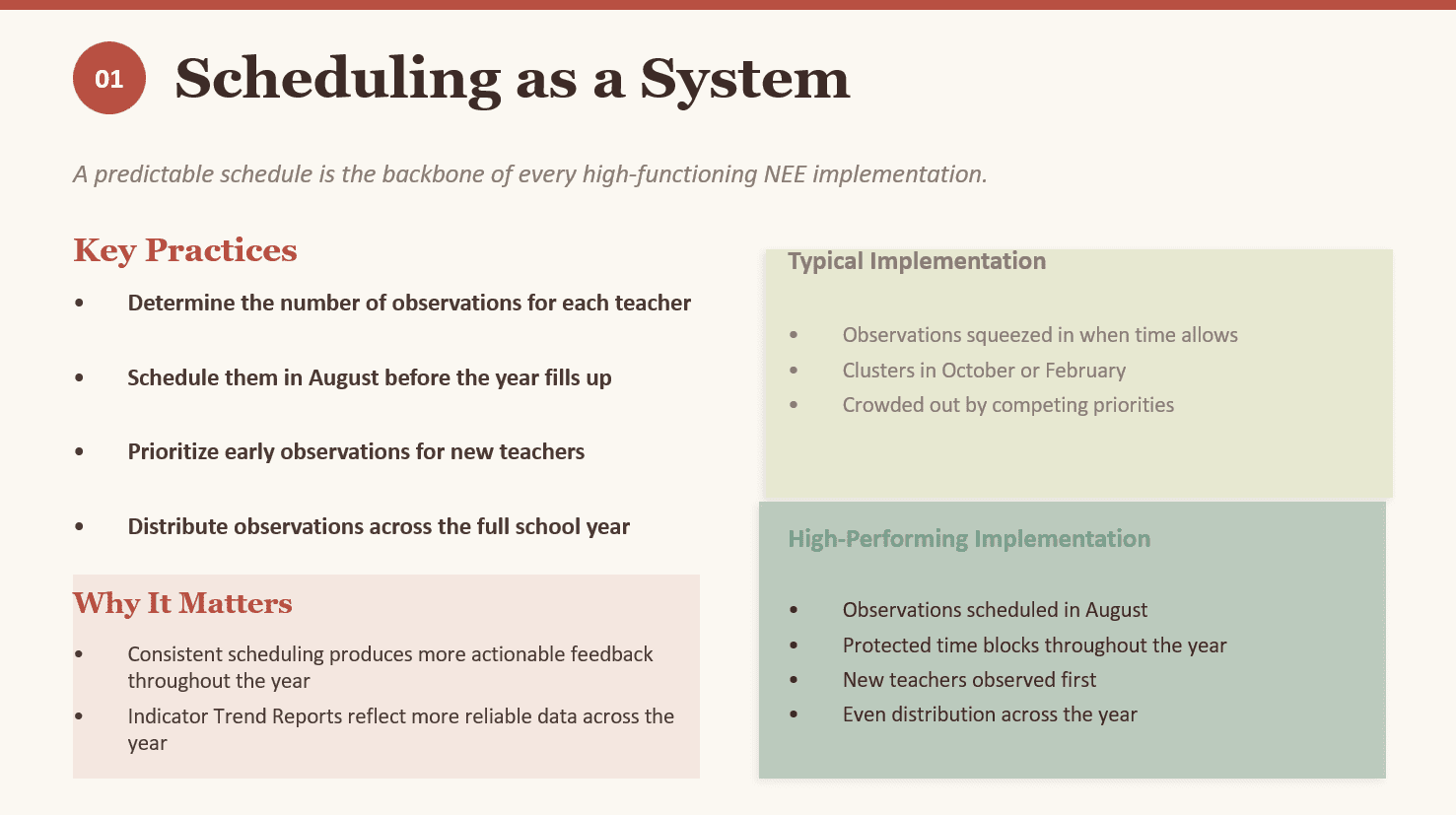
One of the first advanced practices involves the importance of treating scheduling observations as a system rather than an afterthought.
A predictable schedule is the backbone of every high-functioning NEE implementation. In many schools, observations tend to occur in clusters. Administrators often begin the year with good intentions, but once the school year becomes busy, classroom observations are pushed aside until administrators suddenly realize they are behind.
This means teachers do not receive consistent feedback throughout the year, and clustered observations in August/September and then again in February result in distorted and less reliable data.
Several key practices can improve implementation:
- Determine observation counts early: Districts or building leaders should decide early in the school year how many observations each teacher will receive.
- Schedule observations in August: Rather than hoping time will appear later, administrators should proactively block observation time on their calendars before the year fills up. Treat observation blocks the same way you treat required district meetings. Unless there is a true emergency, those blocks should remain protected. Evenly distribute observations across the year to create a more consistent feedback cycle for teachers.
- Prioritize new teachers: New teachers — including teachers who are new to the building — should receive early observations and support. Early feedback allows administrators to identify areas of need quickly and provide assistance before concerns become larger problems.
High-performing implementations are not necessarily about conducting dramatically more observations. Instead, they are about creating a consistent system that allows feedback to occur continuously throughout the year.
Advanced Practices for Evaluator Calibration
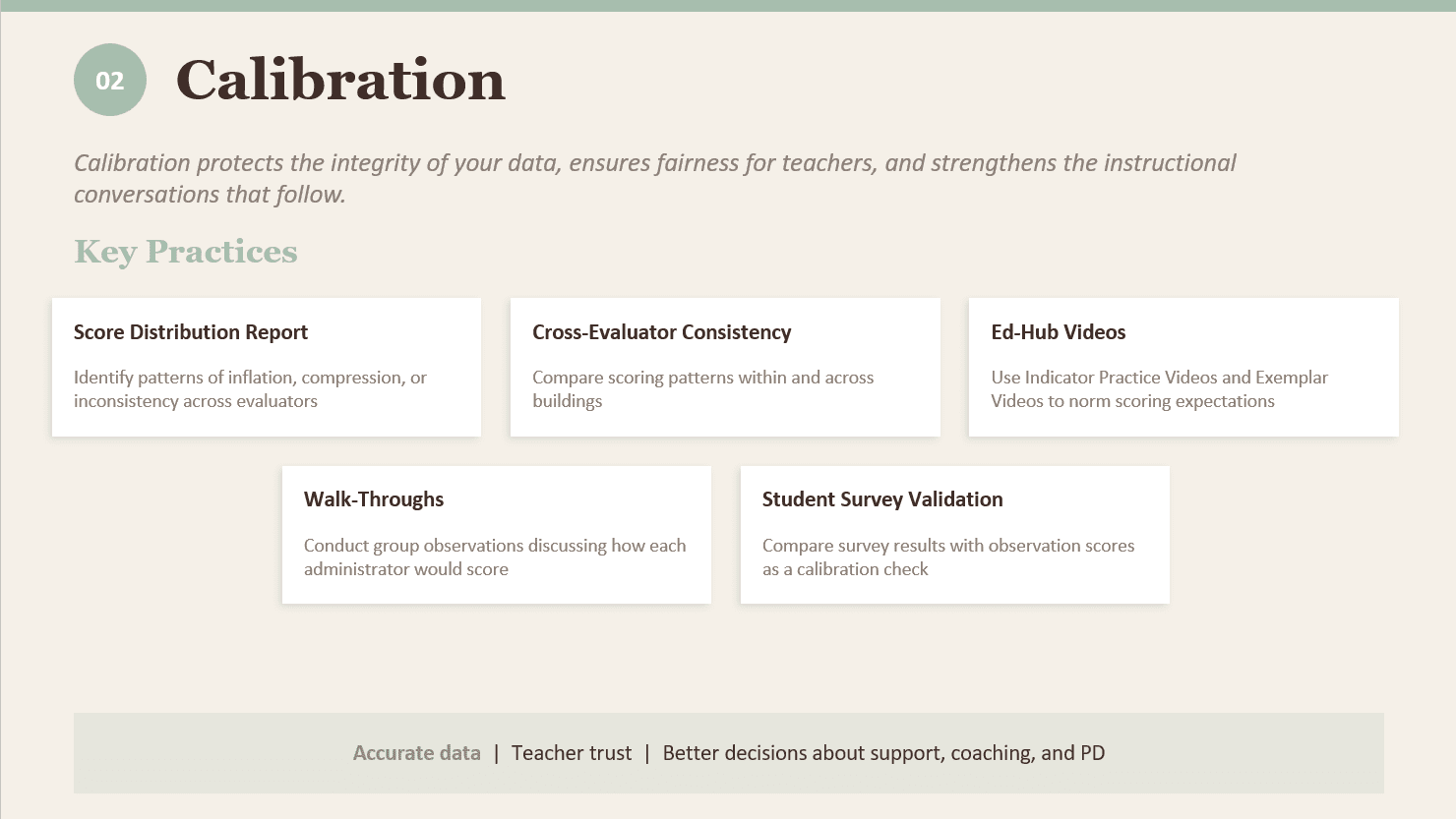
Evaluator calibration ensures each administrator is measuring observations consistently across the district. Calibration protects:
- Accurate data
- Teacher trust
- Better decisions about coaching, support, and professional development
Without calibration, evaluation systems can quickly lose credibility.
Several strategies can help districts strengthen calibration:
- Review score distribution reports: Administrators should regularly review the Indicator Trend Report and Classroom Observation Score Distribution Report. These reports help identify patterns of inflation, compression, or inconsistency.
- Use EdHub videos: Many districts use EdHub Indicator Practice Videos during calibration sessions. Administrators can watch the same video, independently score the observation, and then discuss why they assigned certain scores. This process helps evaluators align their expectations and scoring practices.
- Conduct calibration walkthroughs: Some districts conduct live walkthroughs with small groups of administrators. During these walkthroughs, administrators observe classrooms together and discuss scoring decisions afterward. Although this can initially make teachers nervous, districts that communicate clearly about the purpose often find the process extremely valuable.
- Compare observation data with student surveys: Districts should compare student survey results with classroom observation data. In most cases, these two data sources will be correlated. If they do not align, leaders should investigate why.
Even single-administrator districts can engage in calibration through EdHub videos or by participating in consensus scoring opportunities.
Advanced Practices for Observations
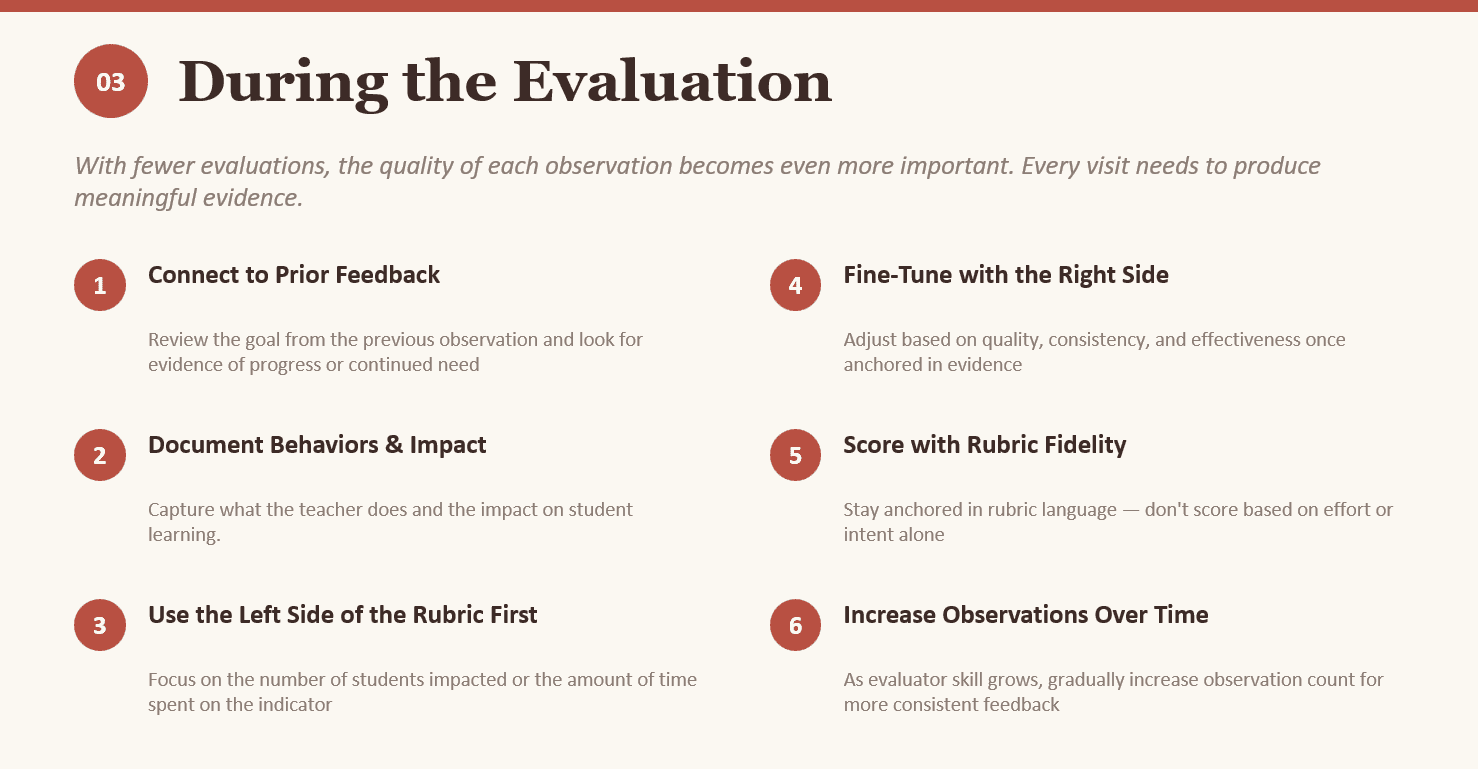
With fewer observations occurring in many districts, the quality of each observation becomes even more important.
Every classroom visit must produce meaningful evidence and actionable feedback by:
- Connecting observations to prior feedback: Rather than constantly shifting focus areas, evaluators should revisit previous goals and look for evidence of growth or continued need. This practice creates a more coherent coaching cycle.
- Focusing on teacher behaviors and student impact: Effective observations should document both what the teacher does and the impact those actions have on students. Administrators should move beyond simply recording activities and instead identify how instructional behaviors influence student learning using impact statements.
- Using the left side of the rubric first: Evaluators should first examine how many students were impacted, how consistently the practice occurred, and how much time was spent on the indicator. Only after establishing that foundation should evaluators move to the right side of the rubric to fine-tune scores based on quality and effectiveness.
- Scoring with rubric fidelity: Scoring should remain grounded in evidence rather than intent. Even if administrators believe they know what the teacher was trying to do, scores should remain anchored in rubric language and observable evidence.
Advanced Practices for Teacher Self-Reflection
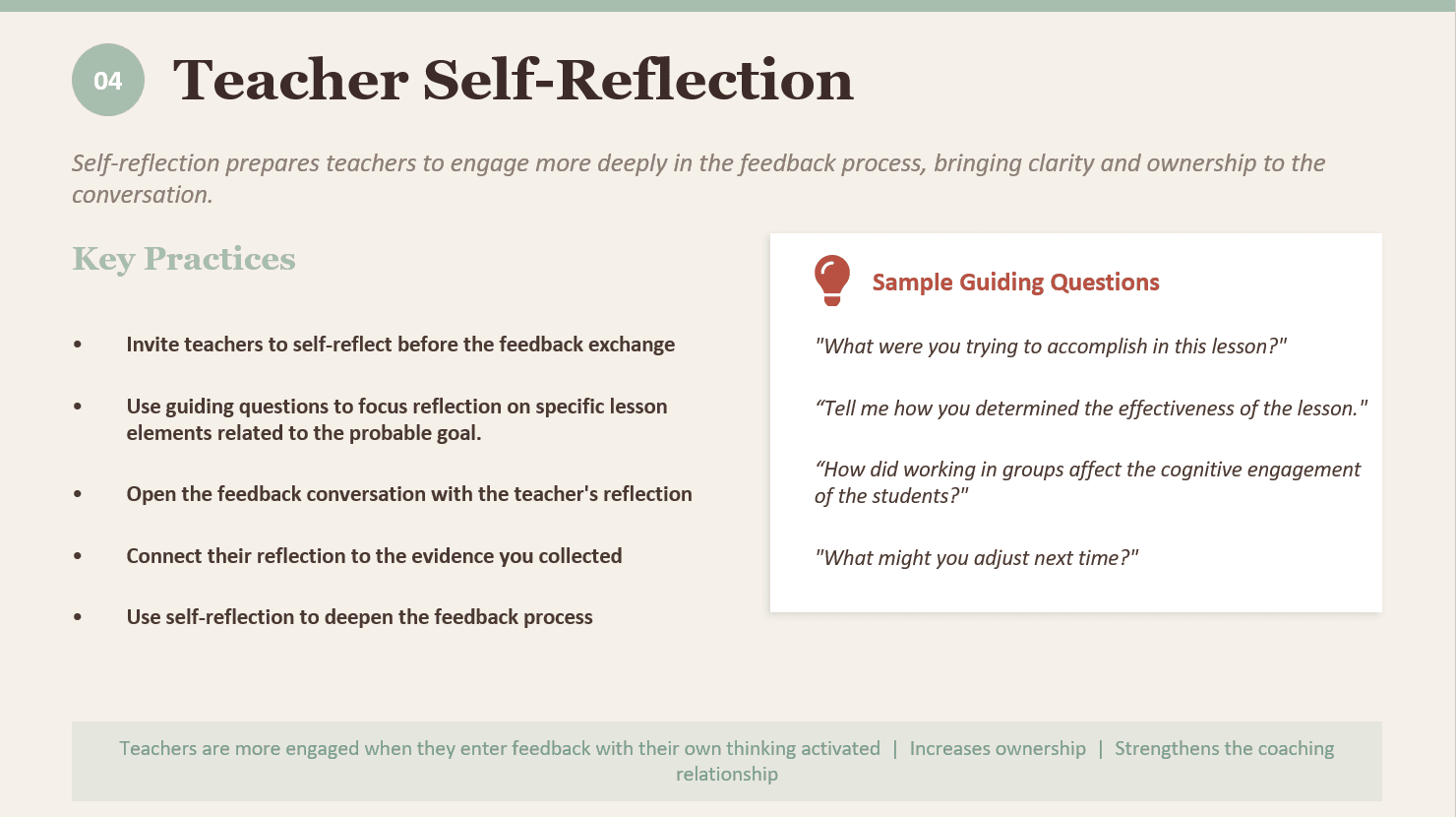
One of the most practical and relationship-centered strategies within advanced NEE implementation is teacher self-reflection.
Teacher self-reflection increases ownership because teachers begin identifying strengths, needs, and next steps themselves. When teachers articulate their own thinking, they are more likely to internalize feedback and act on it.
A few strategies will enhance reflection practices:
- Invite reflection before the conference: Administrators might ask teachers to prepare to discuss how they determined the effectiveness of the observed lesson, how group work affected student engagement, or what adjustments they are considering for next time.
- Start the conference with the teacher: Feedback conferences should begin with the teacher’s reflection rather than the administrator’s observations. This turns the conversation into a collaborative discussion about instruction and student learning.
Reflection should never become a “gotcha” moment. The purpose is not interrogation but thoughtful dialogue.
Advanced Practices for Feedback: Affirmative vs. Instructive
An essential part of advanced implementation is refining feedback practices to support teacher growth.
Before giving feedback, evaluators should determine:
- The focus of the feedback
- The goal of the feedback
- The feedback path
- The type of feedback
Two major feedback types are especially important within NEE: affirmative feedback and instructive feedback.
Affirmative Feedback
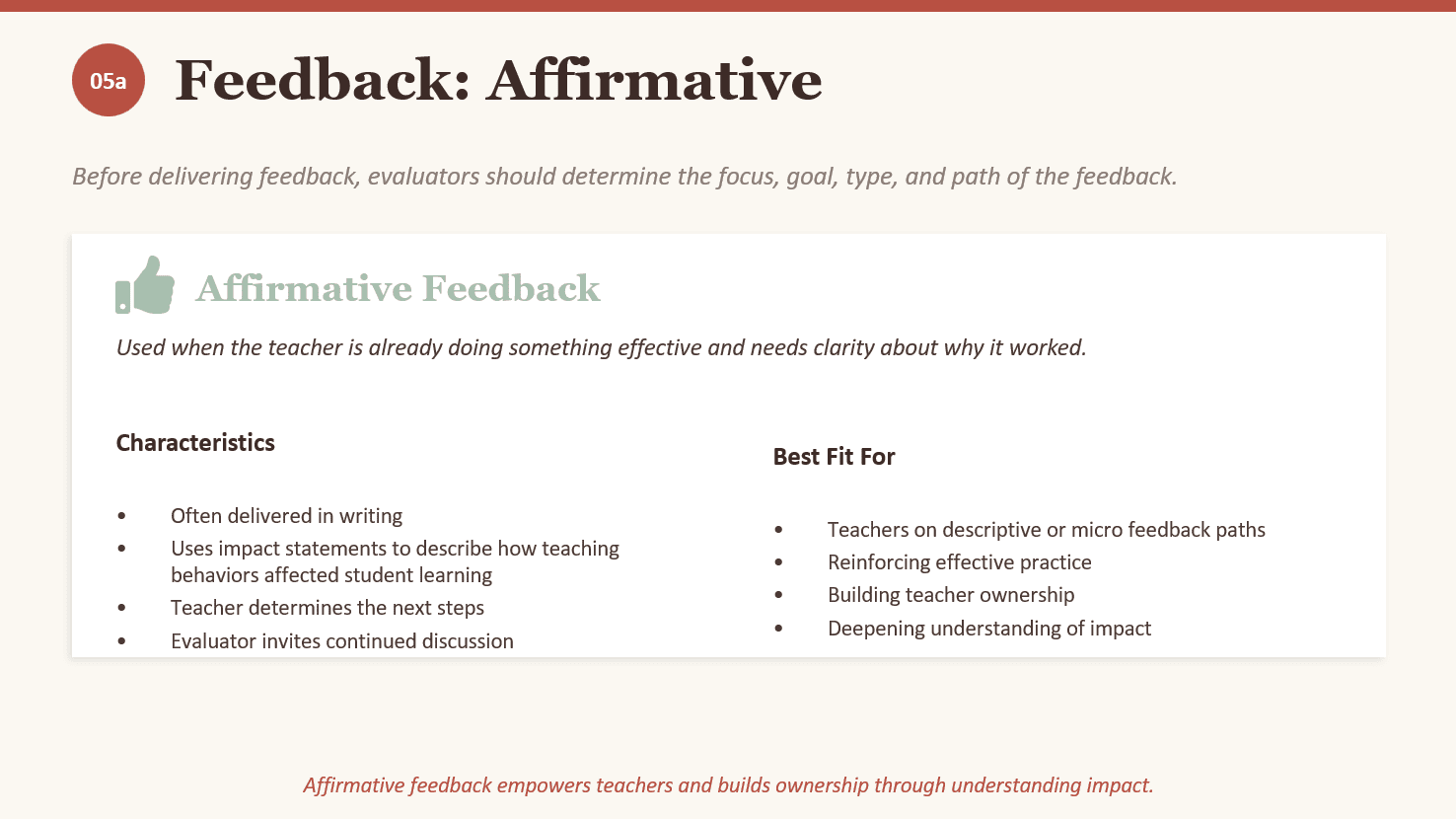
Affirmative feedback is used when a teacher is already doing something effectively.
Its purpose is not to direct improvement but to help teachers recognize why a practice worked and encourage continued growth.
Characteristics of affirmative feedback include:
- Often delivered in writing
- Uses impact statements
- Reinforces effective practice
- Allows the teacher to determine next steps
- Encourages continued reflection and ownership
Affirmative feedback is especially effective for teachers on the descriptive and micro-feedback paths.
An important distinction is that affirmative feedback is not shallow praise. Instead, it clearly identifies the impact of teaching behaviors on student learning.
Instructive Feedback
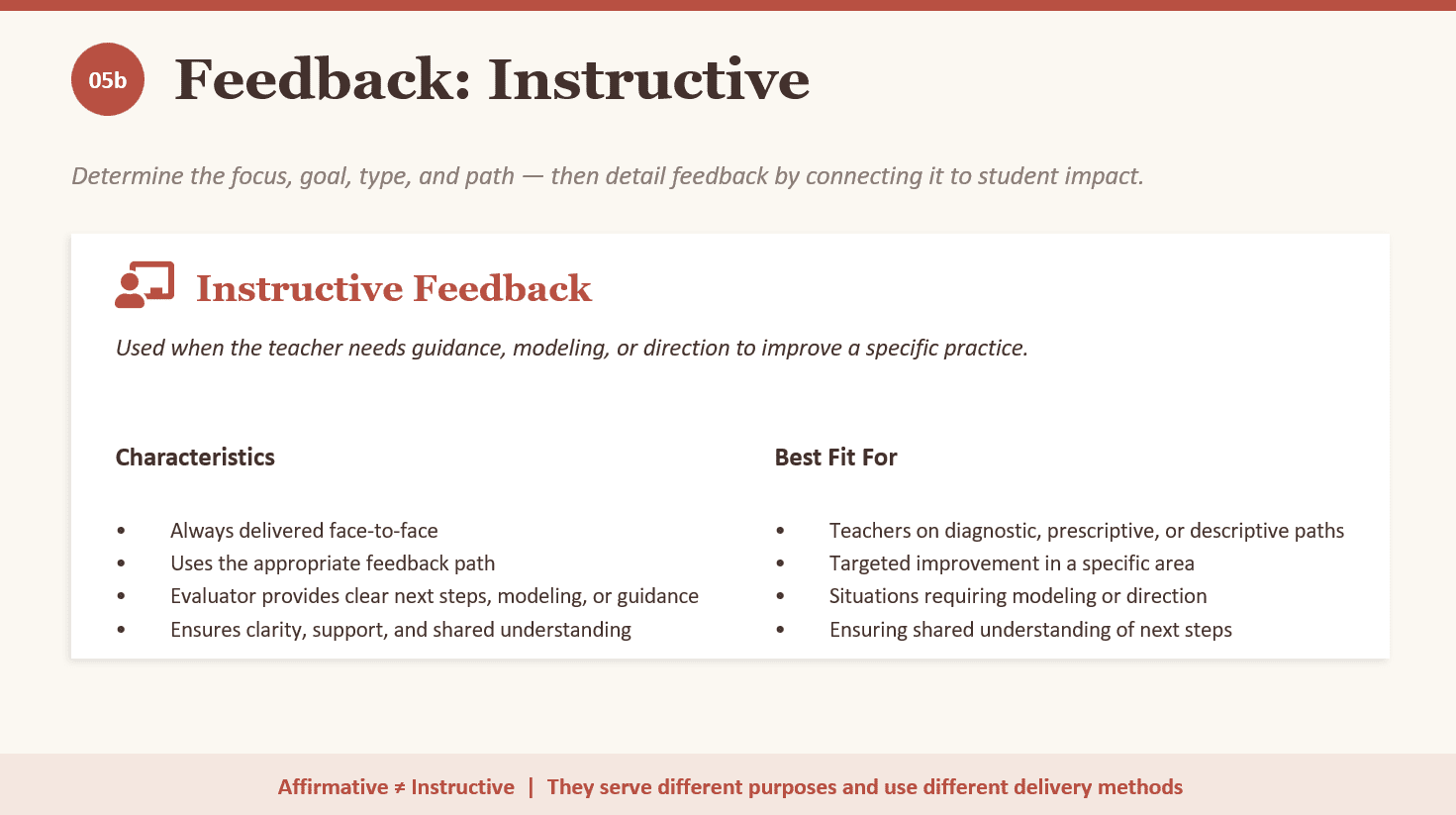
Instructive feedback is used when teachers need guidance, modeling, or direction to improve a specific practice.
Unlike affirmative feedback, instructive feedback is always delivered face-to-face.
Characteristics of instructive feedback include:
- Delivered in person
- Provides clear next steps
- Includes modeling or guidance
- Ensures shared understanding
- Targets specific areas for improvement
Instructive feedback is most appropriate for the diagnostic or prescriptive feedback paths as well as some descriptive feedback situations.
Instructive feedback is designed to create clarity and support. Administrators and teachers work together to determine actionable next steps that improve instruction.
Advanced Strategies for Connecting Observation Data to Professional Development
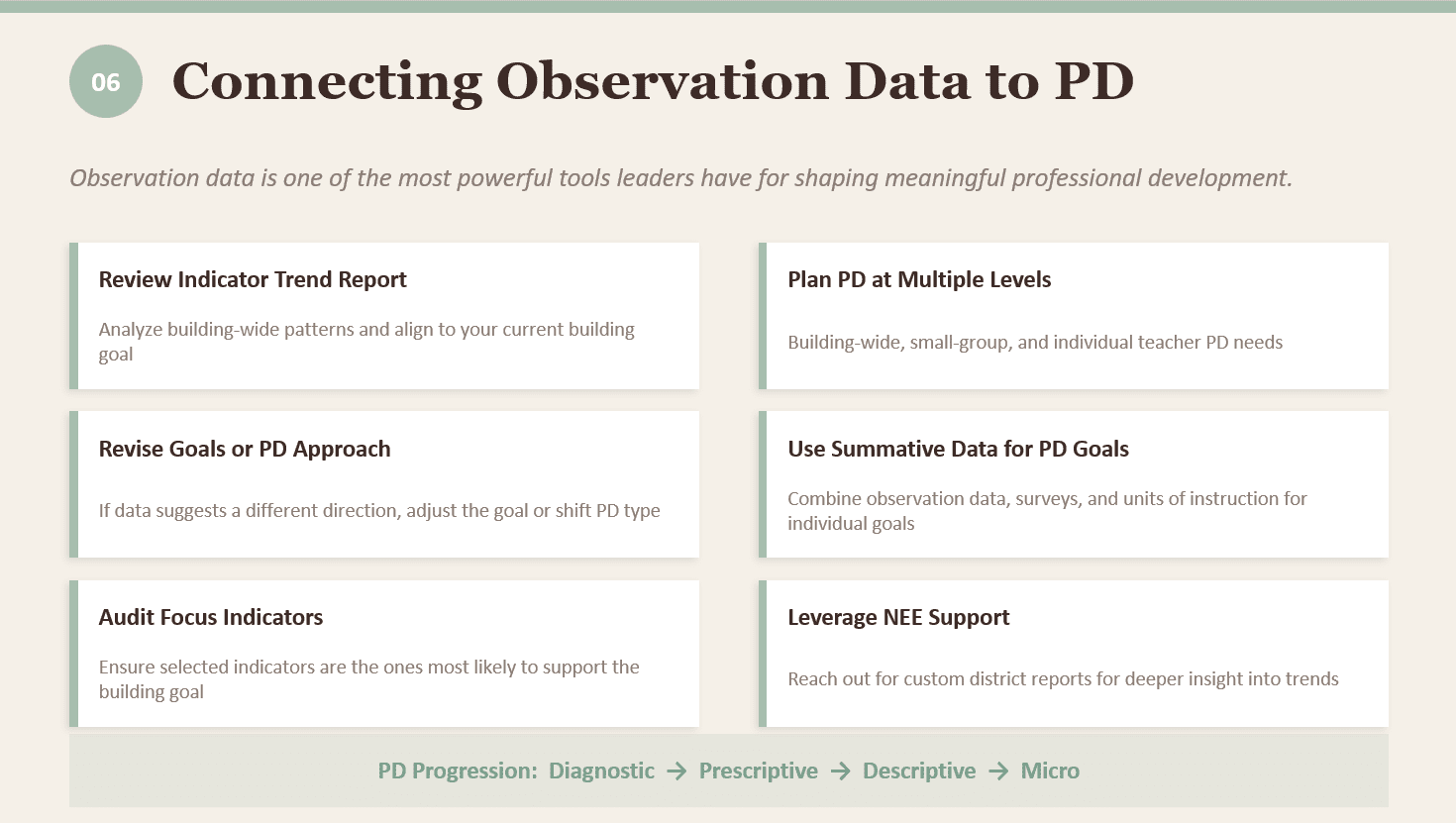
NEE provides several ways for school leaders to connect observation data to meaningful professional development.
- Review the Indicator Trend Report: Leaders should regularly analyze building- and district-wide patterns within the Indicator Trend Report. The report shows aggregate data across all observations to help administrators identify areas of strength, areas of stagnation, and areas needing focused support.
- Audit focus indicators: Schools should regularly evaluate whether their selected focus indicators are truly aligned with building goals. If the indicators are not driving the desired outcomes, they should be revised.
- Plan PD at multiple levels: Effective professional development should occur at several levels: building-wide, small-group, and individual teachers. Editing filters within NEE reports helps leaders identify needs within each of those categories.
- Use summative data to support PD goals: When developing individualized professional development goals, leaders should look at summative reports that combine data from observations, student surveys, units of instruction, and PD plans.
Additional NEE Resources
Several additional NEE resources provide support for advanced implementation:
- EdHub: EdHub provides professional learning videos and resources aligned to NEE indicators.
- District-specific indicator: Districts can create a custom indicator aligned to local priorities and initiatives.
- Executive coaching: NEE offers individualized coaching for principals focused on improving instructional leadership practices.
- POWERHub: The NEE POWERHub supports meaningful peer observation processes and reflection.
- Specialist organizers: Specialized evaluation tools are available within NEE for principals, instructional coaches, counselors, speech-language pathologists, librarians, and paraprofessionals. The NEE Professional Responsibility tool provides schools a way to evaluate additional positions.
- Monthly implementation checklist: The monthly implementation checklist helps leaders organize year-round implementation tasks for observations, student surveys, PD plans, units of instruction, and summative evaluations.
Advanced NEE Implementation: Bringing It All Together
The strength of NEE comes from how all the components work together.
A coherent cycle of implementation includes:
- Observing with purpose
- Calibrating for consistency
- Providing intentional feedback
- Analyzing data for patterns
- Aligning professional development to data
- Connecting evidence to summative evaluations and PD plans
When districts treat NEE as a connected improvement cycle rather than a checklist of tasks, evaluation becomes far more meaningful.
Teachers receive clearer feedback.
Professional development becomes more targeted.
Instructional conversations improve.
Most importantly, schools create a culture focused on continuous growth rather than compliance.
Advanced implementation is not about adding more tasks. It is about using the existing pieces of NEE more intentionally, more consistently, and more strategically to support both teachers and students.
In the end, the power of NEE is not found in any single observation, survey, or report. The power comes from intentional leadership, consistent scoring, thoughtful feedback, and a commitment to continuous improvement across the entire system.
Aaron Jones, Ed.D., is a trainer and field support representative for the Network for Educator Effectiveness. He joined NEE in 2024 after spending more than 30 years in K-12 education as a teacher, principal, and assistant superintendent.
The Network for Educator Effectiveness (NEE) is a simple yet powerful comprehensive system for educator evaluation that helps educators grow, students learn, and schools improve. Developed by preK-12 practitioners and experts at the University of Missouri, NEE brings together classroom observation, student feedback, teacher curriculum planning, and professional development as measures of effectiveness in a secure online portal designed to promote educator growth and development.