New Report Adds Flexibility with Displaying Classroom Observation Scores
The Network for Educator Effectiveness is excited to announce the release of a new report option that provides school districts with greater control over how classroom observation data is viewed by teachers in their district. This report, titled “Classroom Observation – Brief Reports,” introduces an option for districts to decide whether to include or exclude numeric scores in the classroom observation report available for teachers.
Please note, scores from classroom observations will still be entered and accumulated within the Summative Report.
Previously, classroom observation scores were a focal point on NEE’s classroom observation report. After conversations with teachers, district leaders, and building leaders, it became apparent that these scores may limit feedback conversations and take away focus from effective teaching practices. Using those conversations, along with new research on effective feedback, NEE wanted to provide districts more flexibility with how classroom observation reports are viewed. This new report option acknowledges the ongoing debate surrounding observation effectiveness and empowers districts to tailor their evaluation process to their specific needs and contexts.
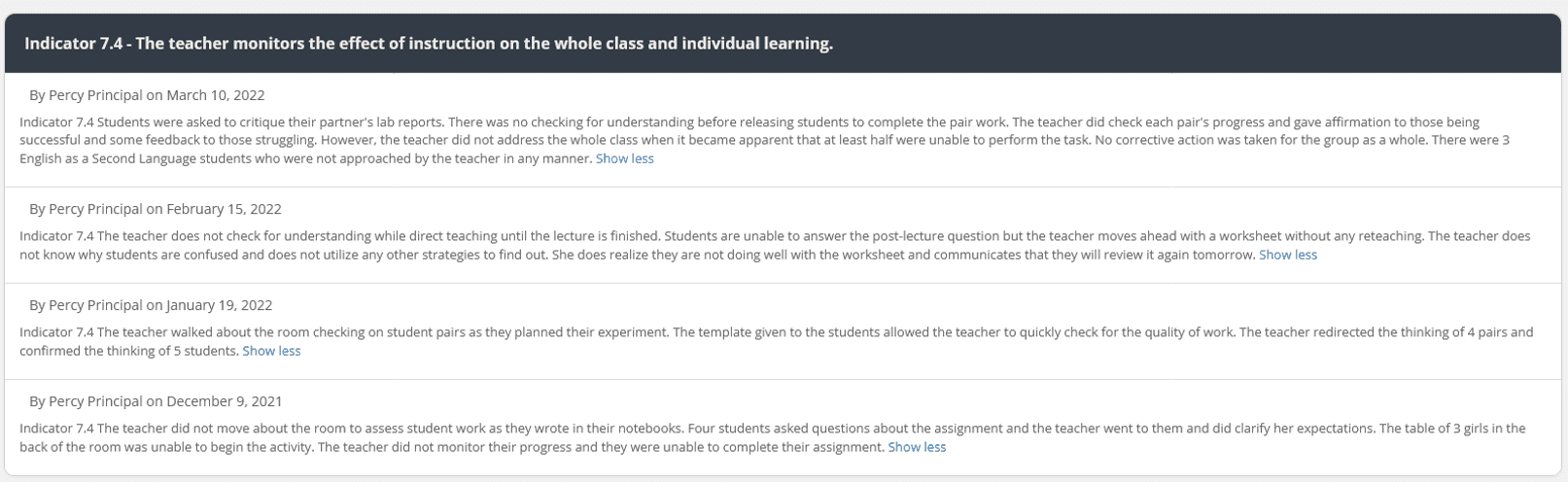
It’s a district choice: Districts can now choose whether to toggle on the Classroom Observation – Brief Report within the NEE platform. When the “Classroom Observation – Brief Report” is toggled on, teachers will not see the scores from the scoring rubrics. Instead, they will see the comments associated with the observed indicators, as well as any general comments the evaluator enters. This puts the onus on the evaluator to leave specific and detailed evidence that informs the teachers of what was happening during the observation. This specific, detailed evidence is a catalyst and absolutely necessary for feedback conversations.
When the Classroom Observation – Brief Report is toggled on by a district, building and district level leaders will be able to view the regular Classroom Observation Report with scores and comments as well as the Classroom Observation – Brief Report that teachers will see.
NEE believes this new report fosters a more adaptable and responsive approach to teacher evaluation. Districts can leverage the power of the NEE system while maintaining control over how classroom observation data is used.
To activate the Classroom Observation – Brief Report:
- A user with District access logs in to the NEE Data Tool and clicks on their name in the upper right hand corner. From the drop-down menu, click My Districts.
- On the My Districts page, click the Edit button to make the School District box editable.
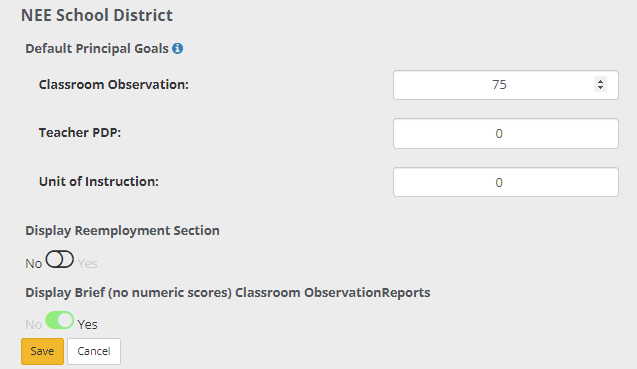
- Once the School District box is editable, you will see a new option at the bottom of the gray box that reads Display Brief (no numeric scores) Classroom Observation Reports. Toggle that box on (Yes) to make classroom observation reports for teachers show up as comments only without scores.
- If you want scores to continue to appear on classroom observation reports for teachers, make sure the Display Brief option is toggled off (No).
If the Classroom Observation – Brief Report is toggled on, below is an example of what the teacher will see when they open up a classroom observation report. Building level users and District level users will also be able to see this version of the report following these steps:
- Click My Teachers on the left-side menu.
- In the Reports section, click Classroom Observation – Brief Report.
- Select the teacher whose report you want to view.
NEE remains committed to supporting educator effectiveness through innovation and adaptability. We encourage districts to explore this new report and determine the best approach for their teachers and leaders.
The Network for Educator Effectiveness (NEE) is a simple yet powerful comprehensive system for educator evaluation that helps educators grow, students learn, and schools improve. Developed by preK-12 practitioners and experts at the University of Missouri, NEE brings together classroom observation, student feedback, teacher curriculum planning, and professional development as measures of effectiveness in a secure online portal designed to promote educator growth and development.