
Guide to Using NEE’s Teacher Professional Development Plan
The Teacher Professional Development Plan (TPDP) is one of four measures that can be incorporated in a teacher’s summative evaluation with the Network for Educator Effectiveness.
The PD plan is designed to guide a teacher’s professional growth through the school year. Many states require teachers and other instructional personnel to complete a PD plan each year, but compliance aside, PD plans truly can be a meaningful process between teachers and school leaders to support professional growth.
A teacher’s PD plan should be unique to the needs of the individual teacher. With NEE, teachers select one goal to work on for the school year. The goal might be related to an area in which they want to improve, or an area they simply want to learn more about. Teachers and administrators can analyze classroom observation scores, student survey results, and other data from prior years to determine a focus for the TPDP.
The TPDP is structured to encourage periodic check-ins between teachers and administrators. There are three phases of the NEE TPDP: pre-implementation review, mid-year review, and end-of-year review. During each phase, the teacher completes part of the PD plan and submits it for review and approval. If PD plan scores are included in the teacher’s summative evaluation, evaluators score the plan during the end-of-year review.
Let’s look at how the NEE system helps teachers work through their professional development goals and how principals support them throughout the process.
Beginning the Teacher Professional Development Plan
NEE recommends that teachers determine their focus for professional learning and then start the new TPDP on NEE’s Word Document version of the plan. This allows teachers to begin work on their plans in the spring before the online organizer is available in the NEE Data Tool online system. More importantly, teachers sometimes get “timed-out” while composing their PD plans in the online tool. Composing on the Word Document and saving it to a local drive provides the teacher with a back-up of their plan. The Word Document version of the TPDP organizer is available on the Help and Resources menu in the NEE Data Tool.
Creating the TPDP Organizer
Once the online version of the organizer becomes available (usually in early July), teachers access it through My Organizers in the NEE Data Tool. When creating the TPDP, teachers have the option to copy a previous year’s plan, which is a good choice if the new plan is a continuation of a previous focus. Teachers may also select the school year, building assignment (if multiple, select where the PD plan will be scored), and teaching status.
Teachers who began their plans on the Word Doc version simply copy and paste from it into the online organizer, being careful to only select the text for each section and not any of the table formatting, which will copy over as code. Teachers should click Save often as they work through each section of the online organizer.
As teachers complete and submit sections of the TPDP throughout the school year, evaluators receive a notification on their NEE Dashboard under Pending Reports. The notification tells them which section of the TPDP is ready for review and provides a link to view the name of the teacher and open the plan.
NEE TPDP Pre-Implementation Review
Teachers complete three sections of the plan before submitting it to their administrator for pre-implementation review and approval.
- Section A asks the teacher to identify their professional growth focus and describe how it aligns to district goals, building goals, NEE indicators, and individual goals. Teachers also describe the data used to determine the goal, suggested activities, and the research base. NEE recommends teachers use only one goal for a school year with three action steps.
- Section B asks the teacher to explain how the selected goal will involve collaboration with other educators and how achievement of the goal will improve the teacher’s ability to increase student engagement and/or meet the needs of diverse learners. Collaboration, student engagement, and meeting the needs of diverse learners are all important components of professional development and student achievement.
- Section C asks the teacher to discuss any prior professional learning that relates to the current goal. First-year teachers simply enter N/A for this section.
The pre-implementation approval process gives administrators a chance to meet with each teacher to discuss their goal, the data used to determine the goal, the sequence of intended professional development activities, and the research base or foundation behind the selected PD activities. The administrator can suggest revisions if necessary and then approve pre-implementation of the plan.
NEE TPDP Mid-Year Review
NEE intends for teachers and administrators to review the plan about halfway through the school year. The mid-year narrative includes Section D, which asks teachers to record their progress in completing the planned professional learning activities. Teachers can work on this section as learning activities occur or wait to enter their progress until shortly before the mid-year review.
When teachers submit the mid-year narrative portion of their plan, the evaluator provides feedback and approves that phase of the plan. Some evaluators choose to meet with teachers to discuss their progress while others share feedback through the comments section of the online organizer.
NEE TPDP End-of-Year Review
The end-of-year narrative includes three sections to be completed by the teacher:
- Section F asks teachers to share data that indicates the progress that was made toward completion of the specific TPDP goal.
- Section G asks teachers to report the progress and/or completion of the goal.
- A final section is reserved for teacher Comments about their professional growth during the school year.
After teachers have submitted the final portion of the TPDP, the evaluator can enter comments, approve the last phase, and score the plan. Some schools complete this portion of the TPDP prior to completing the summative evaluation so the scores will be reported on that year’s summative report. Generally, this occurs in February or March.
Other schools allow the TPDP to proceed until closer to the end of the school year to give teachers more time to complete their plan. In that case, the TPDP scores for that year would generally roll over to the teacher’s next summative report (assuming a teacher summative report had been completed in March).
Still other schools follow the full process for creating, approving, and reviewing progress and completion of teacher PD plans but choose to leave them unscored. Any of the three methods is perfectly acceptable; however, it is best to follow the same process for all teachers within a school district.
Providing Feedback on the TPDP
Feedback is an important component of all teacher evaluation processes, including the TPDP. Teachers need effective feedback on their progress to achieve their goals for improving instructional skills. Each phase of the TPDP process provides opportunities for the evaluator to provide feedback, help the teacher fine-tune their plan, and offer additional or different supports. Some administrators schedule feedback sessions with their teachers specifically to discuss the pre-implementation, mid-year, and end-of-year phases of the TPDP. Other administrators incorporate TPDP feedback into the conferences that follow classroom observations. Still other administrators provide written feedback on the TPDP through email or the comments section of the online organizer. When feedback is provided by entering comments on the organizer, the administrator should alert their teachers when comments have been completed because an automatic email is not generated by the system.
Editing Sections of the TPDP
The TPDP was designed so that teachers create their plan and submit it for approval. If they later realize that changes need to be made, the changes can be recorded in the mid-year or end-of-year sections of the plan and approved by the evaluator. However, if previously approved sections of the TPDP need to be edited, the administrator can “unapprove” the pre-implementation section of the plan. This will unlock those previous sections for editing. The teacher can make the necessary changes and resubmit the plan for evaluator approval.
TPDP Status Report
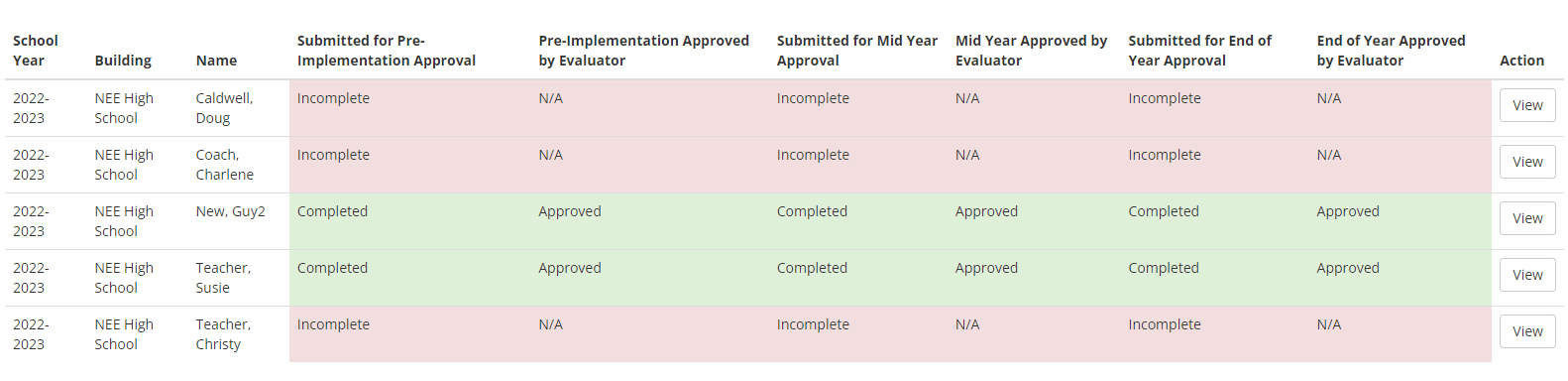
Administrators can check to see how the whole faculty is progressing in the TPDP process by accessing the TPDP Status report. This report displays the name of every teacher in the building who has created a TPDP for that school year. The names of teachers who have not yet created a TPDP for the school year do not appear on the list.
When the TPDP has been submitted and approved at each phase of the process, the status report displays that change in status. The TPDP Status report is incredibly helpful in tracking both the teacher’s and evaluator’s completion of the steps in the TPDP process. You can access the status report under Status Reports in the NEE Data Tool.
Scoring the NEE Teacher Professional Development Plan (TPDP)
A TPDP can be scored at any point during the school year. However, most school districts score their teachers’ plans either right before the summative report is completed (February/March) or at the end of the school year (April/May).
During scoring, the teacher’s plan is displayed on the screen along with the NEE scoring rubric and scoring buttons for each section/element. A comment box is provided for each element in addition to one for general comments at the bottom of the form. When finished, the administrator clicks Complete and an automatic email is sent to the teacher, so they know scores are available for viewing in the NEE Data Tool.
If necessary, the TPDP can be edited after clicking the Complete button. Both scores and comments can be edited up until the summative report is completed.
Additional training on the NEE Teacher Professional Development Plan is available in EdHub by clicking the NEE Training Materials topic.
If you have more questions about using NEE’s Teacher Professional Development Plan, contact the NEE Help Desk at 844-793-4357 or nee@missouri.edu.
The Network for Educator Effectiveness (NEE) is a simple yet powerful comprehensive system for educator evaluation that helps educators grow, students learn, and schools improve. Developed by preK-12 practitioners and experts at the University of Missouri, NEE brings together classroom observation, student feedback, teacher curriculum planning, and professional development as measures of effectiveness in a secure online portal designed to promote educator growth and development.